

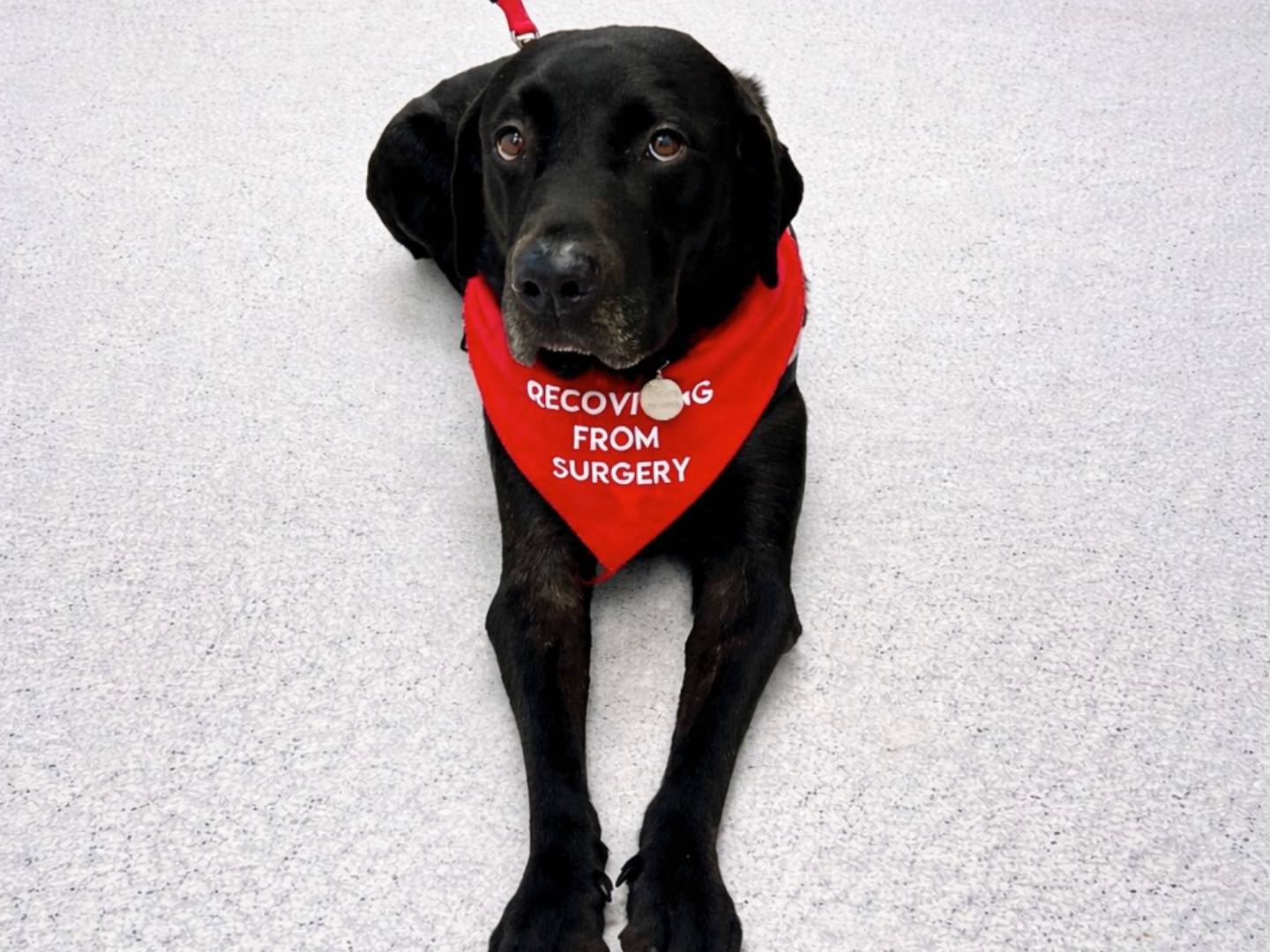
Bringing your pet home after orthopaedic surgery can feel a little daunting. You may be wondering how much they should move, how to keep them comfortable and what signs could suggest that something is not quite right.
At The Moores Orthopaedic Clinic, we know that good care at home is an essential part of a successful recovery. Every operation and every patient is different, so you should always follow the personalised instructions provided by your veterinary team. However, the following advice covers some of the most important ways you can support your pet during their recovery.
What to expect in the first few days after surgery
The first few days at home are an important part of your pet’s recovery. They may initially be quieter or sleepier than usual following their anaesthetic and surgery, but you should see them gradually become brighter and more comfortable.
After many orthopaedic procedures, we expect pets to begin putting some weight through the operated leg within the first few days. Don’t worry if they are cautious initially, but you should notice a gradual and steady improvement in how they use the limb. If your pet is still completely avoiding the leg around seven days after surgery, or if they were using it well and then suddenly become more reluctant to do so, contact your veterinary team for advice.
Keeping the surgical wound clean is particularly important during the first 10 days. Make sure your pet sleeps on clean bedding and avoid allowing them to lie on dirty floors or outside. If their usual bed cannot be machine washed, placing a clean sheet over it and changing this regularly is a simple way to keep their recovery area clean.
Physiotherapy can also be a valuable part of recovery following orthopaedic surgery and, in many cases, can begin soon after your pet leaves hospital. Your veterinary team can advise you on when to start and help you find an appropriately qualified animal physiotherapist. Hydrotherapy using an underwater treadmill may also be introduced once the surgical wound has healed, depending on the procedure performed. Swimming, however, should only be introduced when specifically advised by your veterinary team.
Most importantly, remember that every pet and every operation is different. Your discharge instructions will contain specific guidance for your pet, so always follow these rather than general recovery advice. If anything doesn’t seem right during those first few days, get in touch. We’d much rather hear from you early and make sure your pet’s recovery is progressing as expected.
Prepare a safe and comfortable recovery space
Before your pet comes home, create a quiet area where they can rest without being disturbed by other pets, young children or everyday household activity.
The space should be warm (or cool depending on the season), comfortable and large enough for your pet to stand up, turn around and lie down, but not so large that they can run or jump on or off furniture. Depending on your pet and the operation performed, a crate, puppy pen or small room may be recommended.
Use supportive, non-slip bedding and make sure food and water are within easy reach. Slippery floors can make it difficult for pets to move safely after surgery, so place rugs, runners or non-slip mats along any routes they need to use.
Stairs should usually be avoided during the early stages of recovery. Baby gates can help prevent accidental access, while a ramp may be useful where steps cannot be avoided. Ask your veterinary team before using a ramp, as it may not be suitable for every patient.
Restrict activity, even when your pet feels better
Rest is one of the most important parts of orthopaedic recovery. Bones, joints, ligaments and other tissues need time to heal, and too much activity too soon can place strain on the surgical repair.
One of the biggest challenges for owners is that pets often begin to feel better before healing is complete. Your pet may appear eager to run, jump or play, but this does not mean the operated area is ready for normal activity.
During the early stages of recovery, your pet will probably need to be kept on a lead whenever they leave their recovery area, including in the garden. Exercise should be limited to the duration and type advised by your veterinary team. This may begin with short, controlled toilet walks before gradually increasing over several weeks.
Avoid running, jumping on and off furniture, energetic play, chasing toys and rough play with other animals until your pet has been given permission to resume these activities. The exact restriction period will depend on the procedure and your pet’s progress.
Help your pet move safely
Some pets may be unsteady or reluctant to use the operated limb when they first return home. This can be due to discomfort, weakness or the lingering effects of an anaesthetic.
A harness can help you guide a dog without pulling on their neck. A harness with a handle such as those from ‘Julius-K9’ can be particularly helpful, especially after forelimb surgery. In some cases, your veterinary team may recommend supporting their back end with a sling or folded towel when walking or helping them outside.
Move slowly and calmly, particularly when helping your pet get in or out of the car. Do not allow them to jump from the boot or seats. Your pet should be lifted in and out of the car and for larger dogs this may require two people.
Cats may try to jump onto furniture or windowsills, so they may need to be kept in a crate or a small room with low-level bedding, food, water and a litter tray while they recover.
Give all medication exactly as prescribed
Your pet may be sent home with pain relief, anti-inflammatory medication, antibiotics or other medicines. Give each medication at the correct dose and time, and complete the course unless your vet advises otherwise.
Do not give human painkillers or medication prescribed for another animal. Some human medicines can be highly toxic or even fatal to pets.
Contact your veterinary team if your pet is difficult to medicate, vomits after receiving medication or develops diarrhoea, vomiting, a reduced appetite or any other unexpected symptoms. Do not stop or change medication without veterinary advice.
Good pain relief does more than keep your pet comfortable. It can help them settle, sleep and begin using the affected limb appropriately when it is safe to do so.
Prevent licking and chewing
Pets naturally want to lick an area that feels uncomfortable, but licking can introduce bacteria, irritate the skin and cause the wound to open.
Your pet may need to wear a protective collar or recovery suit. It is important to use this for as long as advised, including overnight and whenever your pet is unsupervised. A few minutes of licking can be enough to damage a surgical wound or to cause an infection.
Check that the collar fits correctly and does not prevent your pet from eating or drinking. Bowls can sometimes be raised slightly to make this easier, but the protective device should not be removed unless your veterinary team has said it is safe to do so. If your pet does not get on with a ‘cone’ collar (often referred to as an Elizabethan collar or Buster collar) you might like to try an inflatable ring collar (search for ‘comfy dog recovery collar’).
Caring for a bandage or wound dressing
If your pet goes home with a bandage or wound dressing, looking after it carefully is an important part of their recovery. Although uncommon, problems caused by a poorly fitting, wet or damaged bandage can become serious if they are not identified quickly.
Keep the bandage clean and dry at all times. If you need to take your pet outside in wet weather, your veterinary team may advise using a waterproof covering for short toilet trips. This should be removed again as soon as your pet is back indoors to prevent moisture building up underneath.
Check the bandage at least twice a day. Contact us or your local vet as soon as possible if:
- The bandage has slipped, twisted or become loose
- It becomes wet, dirty or damaged
- You notice any discharge, staining or unpleasant smell
- Your pet suddenly seems more uncomfortable or starts chewing at the bandage
- The exposed toes or claws become swollen or begin to spread apart
Where your pet’s claws are visible below the bandage, checking them twice daily can help you spot swelling early.
Depending on your pet’s procedure, a bandage may need to remain in place for around 10–14 days, with bandage changes during this period. For example, the first change may be recommended after 4–6 days. However, this will vary between patients, so always follow the individual instructions provided by your veterinary team.
Often there will be no need for a bandage but your pet will have an adhesive dressing (known as a Primapore) covering the wound when they go home. This should remain dry and it should be left on until it falls off, which can be after a day or two or longer. Generally they do not need to be replaced and if they are still in place after 7 days then they can be gently removed. If the dressing looks wet because of wound discharge then you should contact the clinic team.
Unless you have been told otherwise, do not apply creams, antiseptics, dressings or home remedies without veterinary advice, and avoid bathing or swimming until the wound has healed.
Taking a photograph of the wound each day can make it easier to notice gradual changes.
Monitor eating, drinking and toileting
It is common for some pets to be quieter than usual or have a reduced appetite during the first day after an anaesthetic. Their appetite should generally begin to improve as the effects of the anaesthetic wear off and they become more comfortable.
Offer a small meal and ensure fresh water is available. Contact your vet if your pet repeatedly vomits, persistently refuses food or water, appears increasingly unwell or has difficulty passing urine or faeces.
Reduced activity, medication and changes in routine can occasionally contribute to constipation so do not be worried if your pet hasn’t been to the toilet for the first day or two of recovery. However, do let your veterinary team know if your pet has not passed faeces for several days or appears uncomfortable when trying.
Know when to contact your vet
Please contact your veterinary team if you are worried about any aspect of your pet’s recovery. Signs that should be discussed promptly include:
- Pain that appears severe or is getting worse
- Sudden reluctance to use the operated limb
- A fall, jump or other accident
- Increasing swelling, redness or discharge
- Damage to a wound, bandage or splint
- Repeated vomiting or diarrhoea
- Difficulty breathing
- Extreme tiredness, weakness or collapse
- Refusal to eat, drink or take medication
- Any change that concerns you
Never feel that you are wasting your vet’s time. It is always better to ask for advice early so that any potential problem can be assessed promptly.
Patience is part of the recovery process
Orthopaedic recovery can take weeks or several months, depending on the condition, procedure and individual patient. Progress may not always be perfectly steady, and some days may be easier than others.
Providing a calm environment, following the exercise plan and attending scheduled rechecks can make a significant difference to your pet’s outcome. With careful support and plenty of patience, most pets will return to their normal exercise and activity levels following orthopaedic surgery.
At The Moores Orthopaedic Clinic, we are here to support you and your pet throughout the recovery journey. Always follow the specific discharge instructions provided for your pet and contact us or your usual veterinary practice if you have any concerns.